
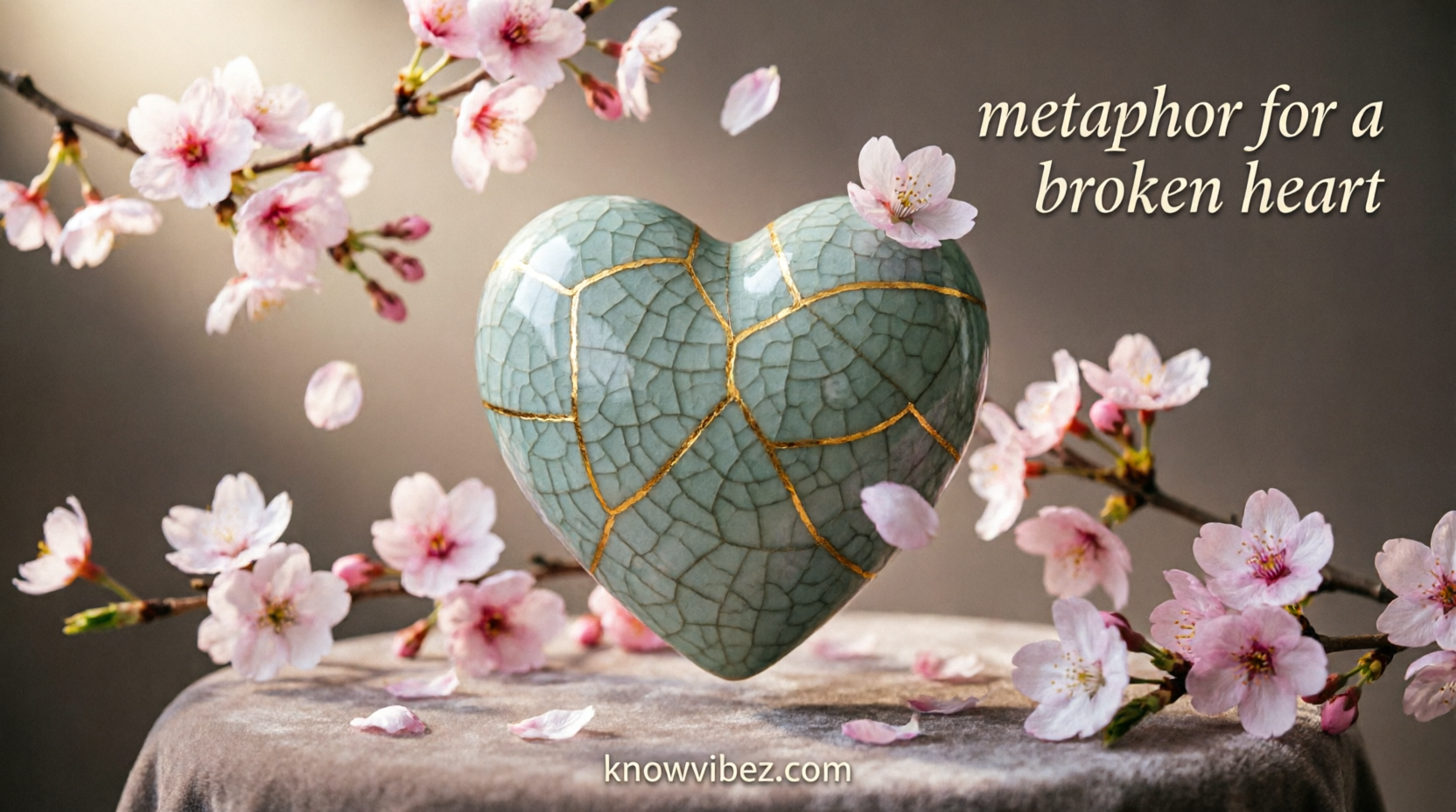
A metaphor for a broken heart describes emotional pain by turning an invisible feeling into a clear picture. Instead of simply saying She was very sad after the breakup you might say Her heart was a shattered window. The heart is not literally made of glass. The image shows that love trust or hope has been badly damaged.
People search for a metaphor for a broken heart when ordinary words feel too weak. Students may need one for an essay or assignment. Writers may want a fresh image for a poem story or novel. Someone writing a social media caption may want a short line that captures heartbreak without explaining the whole story.
In everyday English we already use expressions such as broken heart heartache crushed torn apart and wounded heart. These expressions show how English often treats emotional pain as physical damage.
This guide updated for 2026, goes further. You will find 60 original metaphors, simple meanings, natural sentences, tone and difficulty notes, usage advice conversations mistakes, practice questions FAQs related terms and ready schema.
Definition & Meaning
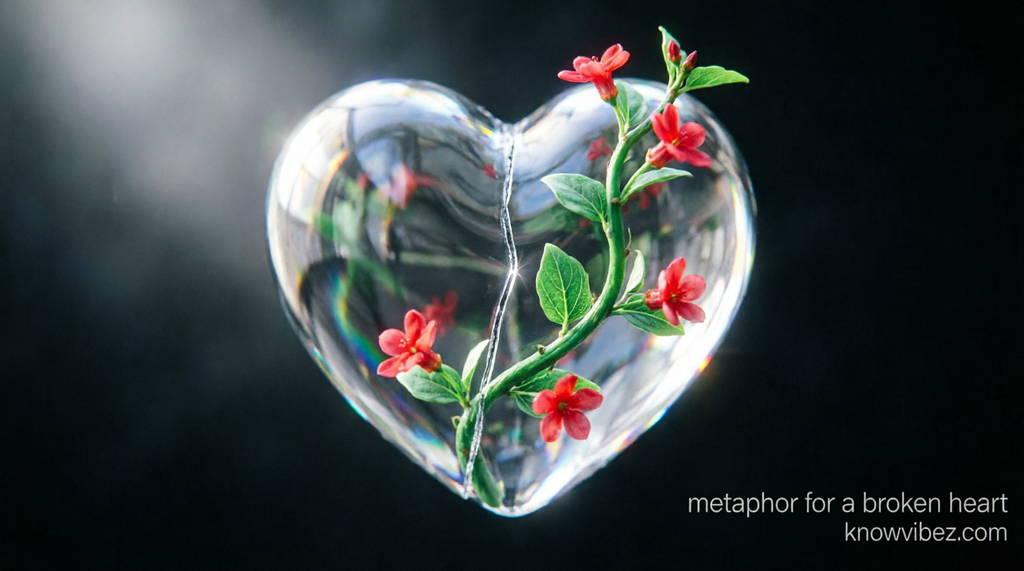
A metaphor for a broken heart is a figurative expression that compares emotional heartbreak with something physically damaged, lost, empty, broken, or wounded. It gives the reader an image for sadness that is difficult to describe literally. A strong metaphor makes the emotion easier to picture and often makes writing more memorable.
Simple Definition
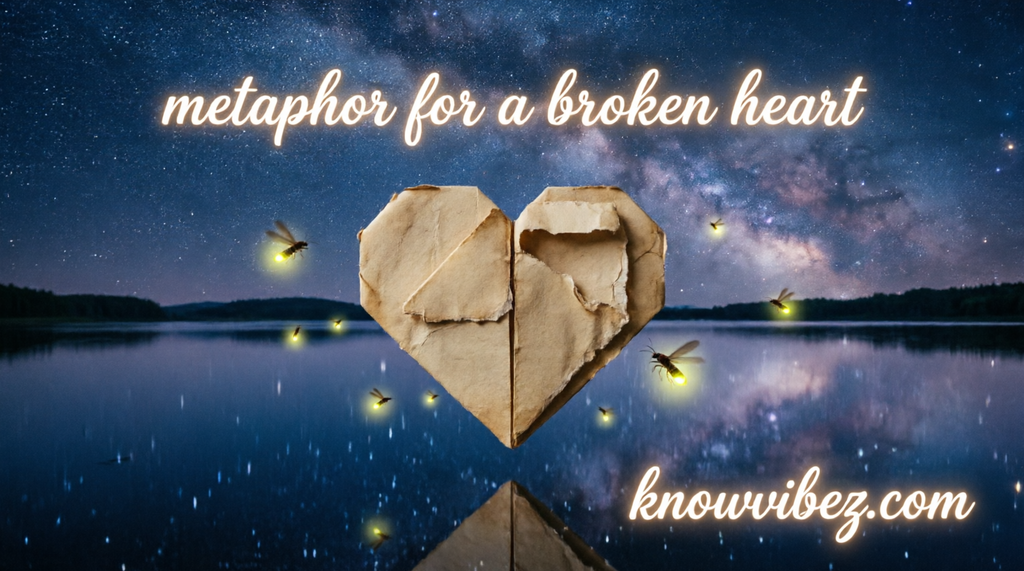
A metaphor for a broken heart is a creative way to describe deep emotional pain without stating the feeling directly.
For example:
“Her heart was a shattered mirror.”
This does not mean her physical heart became a mirror. It means her emotional world feels broken into painful pieces.
A metaphor normally makes a direct comparison without using “like” or “as.” That is one key difference between a metaphor and a simile.
Quick Example
Literal:
“She was deeply hurt after the breakup.”
Metaphor:
“Her heart was a shattered window.”
Simile:
“Her heart felt like a shattered window.”
The last sentence is a simile, not a strict direct metaphor, because it uses “like.”
Quick Reference: What Does Each Image Suggest?
| Expression | Main idea | Emotional strength | Best use |
|---|---|---|---|
| Shattered heart | Severe heartbreak | Very high | Poetry, fiction |
| Cracked heart | Hurt but not destroyed | Medium | Healing stories |
| Wounded heart | Emotional injury | High | Serious writing |
| Empty room | Loneliness | Medium | Personal writing |
| Broken bridge | Lost connection | High | Relationships |
| Dying flame | Love fading | High | Poetry |
| Winter | Emotional coldness | Medium-high | Creative writing |
| Heavy stone | Emotional burden | High | Sadness |
| Torn page | A painful ending | Medium | Essays, captions |
| Storm | Emotional chaos | High | Poetry, fiction |
Quick takeaway: The best metaphor is not always the most dramatic one. Choose an image that matches the exact kind of heartbreak you want to describe.
Why We Use “Metaphor for a Broken Heart”
A metaphor for a broken heart helps turn an invisible emotion into something readers can see, feel, and understand. Heartbreak can include sadness, loneliness, anger, regret, betrayal, confusion, or loss. A carefully chosen image lets you show those differences instead of using the same word—“sad”—again and again.
1. To Make Emotional Pain Clear
“I’m sad” tells the reader the emotion.
“My heart is a house after a fire” shows the emotion.
The second sentence gives the reader an image of damage, emptiness, and loss.
2. To Make Writing More Powerful
Metaphors are common in literature, poetry, speech, advertising, and everyday communication because they can express complex ideas through vivid imagery.
Compare:
- “The relationship ended.”
- “The bridge between us collapsed.”
The second sentence gives the ending a shape.
3. For School Assignments
Students often need figurative language for:
- English essays
- Poetry
- Creative writing
- Literary analysis
- Personal narratives
- Figurative-language worksheets
A metaphor can make a simple sentence more descriptive without making it difficult to understand.
4. For Speaking
People use heart metaphors naturally:
- “That really broke my heart.”
- “I’m carrying a lot of pain.”
- “My heart isn’t in it anymore.”
- “She left me with a lot of emotional scars.”
These expressions can sound more natural than a long explanation.
5. For Social Media
Short metaphors work especially well in captions.
Examples:
“I was a house with the lights turned off.”
“Some goodbyes leave empty rooms behind.”
“The bridge between us burned quietly.”
6. For Creative Writing
A metaphor can also become an extended metaphor.
For example, if heartbreak is described as winter, the writer can continue the image:
Winter entered her heart. The windows froze. The garden stopped growing. Even the morning light felt cold.
The entire passage stays inside one image. That makes the writing feel connected rather than random.
60 Metaphors for a Broken Heart
The following examples are written as direct metaphors, not simple similes. Each one has a different emotional purpose.
1. A Shattered Heart
Meaning: A heart that feels completely damaged after deep emotional pain.
Real explanation: “Shattered” suggests that something once whole has broken into many pieces. It is stronger than simply saying “broken.”
Sample sentence:
“After the betrayal, her heart was a shattered glass.”
When to use it: Use it for severe heartbreak, betrayal, or a painful ending.
When NOT to use it: Avoid it for small disappointments.
Alternatives:
- A broken heart
- A heart in pieces
- A devastated heart
Difficulty: Easy
Tone: Emotional
2. A Cracked Heart
Meaning: A heart that has been hurt but is not completely destroyed.
Real explanation: A crack shows damage without total destruction. It works well when you want to suggest that healing is still possible.
Sample sentence:
“His heart was a cracked cup, still holding the little love he had left.”
When to use it: For disappointment or emotional damage that may heal.
When NOT to use it: Do not use it when describing extreme devastation.
Alternatives:
- A bruised heart
- A damaged heart
- A fragile heart
Difficulty: Easy
Tone: Reflective
3. A Wounded Heart
Meaning: A heart suffering from emotional injury.
Real explanation: The metaphor treats emotional pain as a physical wound. It works particularly well when the pain is still fresh.
Sample sentence:
“Behind his calm smile was a wounded heart.”
When to use it: For betrayal, rejection, grief, or emotional trauma in creative writing.
When NOT to use it: Avoid it when you want a light or playful tone.
Alternatives:
- An injured heart
- A hurt heart
- An aching heart
Difficulty: Easy
Tone: Serious
4. A Broken Mirror
Meaning: A heart that no longer feels whole.
Real explanation: A mirror breaks into separate pieces, and each piece reflects only part of the original image. This makes it useful for describing a person who feels emotionally fragmented.
Sample sentence:
“Her heart was a broken mirror, reflecting pieces of the life she had lost.”
When to use it: Poetry, novels, reflective essays.
When NOT to use it: Avoid it if your writing needs very simple everyday language.
Alternatives:
- A shattered reflection
- A fragmented heart
- A broken image
Difficulty: Medium
Tone: Poetic
5. A Collapsed Bridge
Meaning: A relationship or emotional connection that can no longer connect two people.
Real explanation: A bridge joins two sides. If it collapses, the connection becomes difficult or impossible.
Sample sentence:
“Our love was a collapsed bridge between two lonely shores.”
When to use it: For breakups, separation, or lost trust.
When NOT to use it: Do not use it when the relationship is still strong.
Alternatives:
- A broken connection
- A fallen bridge
- A severed link
Difficulty: Medium
Tone: Reflective
6. A Dying Flame
Meaning: Love that is slowly disappearing.
Real explanation: A flame gives warmth and light. When it dies, the warmth and light disappear too.
Sample sentence:
“Our love was a dying flame, flickering through the final days.”
When to use it: For relationships that fade gradually.
When NOT to use it: Avoid it for sudden betrayal unless you want contrast.
Alternatives:
- Fading fire
- Dying light
- Fading love
Difficulty: Easy
Tone: Poetic
7. A Cold Fireplace
Meaning: A heart that once felt warmth but now feels empty.
Real explanation: A fireplace represents warmth, comfort, and home. A cold fireplace suggests that those feelings have disappeared.
Sample sentence:
“Her heart was a cold fireplace after he left.”
When to use it: For loneliness after a relationship ends.
When NOT to use it: Avoid it for anger-focused heartbreak.
Alternatives:
- An empty home
- A cold hearth
- Lost warmth
Difficulty: Medium
Tone: Poetic
8. An Empty House
Meaning: A heart that feels lonely after someone leaves.
Real explanation: A house can feel empty when the person who made it feel like home is gone.
Sample sentence:
“After the breakup, her heart became an empty house.”
When to use it: For loneliness and absence.
When NOT to use it: Do not use it when the main emotion is rage.
Alternatives:
- An abandoned home
- An empty room
- A vacant heart
Difficulty: Easy
Tone: Emotional
9. A Locked Door
Meaning: A person who has closed their heart after being hurt.
Real explanation: A locked door prevents entry. The metaphor suggests emotional self-protection.
Sample sentence:
“After years of disappointment, his heart became a locked door.”
When to use it: For emotional distance or fear of loving again.
When NOT to use it: Avoid it if the person is openly seeking connection.
Alternatives:
- A closed heart
- A guarded heart
- A sealed door
Difficulty: Easy
Tone: Neutral
10. A Prison
Meaning: A heart trapped by painful memories.
Real explanation: A prison removes freedom. This metaphor suggests that the person cannot easily escape old emotions.
Sample sentence:
“Her heart was a prison built from old memories.”
When to use it: For long-lasting emotional pain.
When NOT to use it: Avoid it for a short period of sadness.
Alternatives:
- An emotional cage
- A memory trap
- A painful prison
Difficulty: Medium
Tone: Dark
11. A Heavy Stone
Meaning: A heart carrying a painful emotional burden.
Real explanation: A heavy stone is difficult to carry. The image transfers that physical weight to emotional sadness.
Sample sentence:
“Grief sat in his chest like a heavy stone.”
When to use it: For grief, regret, or emotional burden.
When NOT to use it: Avoid it when you want to emphasize hope.
Alternatives:
- A heavy burden
- A weight on the heart
- A load of sorrow
Difficulty: Easy
Tone: Serious
12. A Torn Page
Meaning: A painful ending to an important part of life.
Real explanation: A torn page suggests that a story has been damaged or abruptly interrupted.
Sample sentence:
“Our relationship was a torn page in the story of my life.”
When to use it: Essays, captions, memoir-style writing.
When NOT to use it: Avoid it if the relationship is continuing.
Alternatives:
- A ruined chapter
- A lost page
- An unfinished story
Difficulty: Easy
Tone: Reflective
13. A Burned Chapter
Meaning: A painful period that someone wants to leave behind.
Real explanation: A chapter represents a period in a story. Burning it suggests destruction and finality.
Sample sentence:
“That relationship became a burned chapter in her life.”
When to use it: For moving on.
When NOT to use it: Avoid it if the person still hopes to repair the relationship.
Alternatives:
- A closed chapter
- A painful chapter
- A finished story
Difficulty: Easy
Tone: Neutral
14. A Storm
Meaning: Emotional chaos caused by heartbreak.
Real explanation: Storms are noisy, powerful, and difficult to control. The image works well for mixed emotions.
Sample sentence:
“Her heart was a storm she could not explain.”
When to use it: When sadness, anger, fear, and confusion happen together.
When NOT to use it: Avoid it for quiet sadness.
Alternatives:
- Emotional chaos
- A raging sea
- Inner turmoil
Difficulty: Easy
Tone: Dramatic
15. A Ship Without an Anchor
Meaning: A person who feels emotionally lost and unstable.
Real explanation: An anchor keeps a ship steady. Without one, the ship can drift.
Sample sentence:
“After he left, my heart became a ship without an anchor.”
When to use it: For confusion or uncertainty after a breakup.
When NOT to use it: Avoid it when the emotion is specifically betrayal.
Alternatives:
- A drifting heart
- A lost ship
- A wandering soul
Difficulty: Medium
Tone: Poetic
16. A Desert
Meaning: A heart that feels empty, lonely, and without emotional warmth.
Real explanation: A desert can suggest silence, dryness, distance, and lack of life.
Sample sentence:
“After losing her, his heart became a desert.”
When to use it: For emotional emptiness.
When NOT to use it: Avoid it when describing intense emotional chaos.
Alternatives:
- An emotional wasteland
- A barren heart
- A lonely land
Difficulty: Medium
Tone: Poetic
17. A Frozen Lake
Meaning: Feelings that have become cold and difficult to reach.
Real explanation: A frozen lake has water beneath the surface, but the ice blocks access to it. This makes it useful for emotional suppression.
Sample sentence:
“His heart was a frozen lake hiding everything beneath the surface.”
When to use it: For emotional numbness.
When NOT to use it: Avoid it when the person is openly expressing pain.
Alternatives:
- Frozen feelings
- A cold heart
- An icy heart
Difficulty: Medium
Tone: Poetic
18. A Fading Photograph
Meaning: A memory or relationship slowly losing its emotional presence.
Real explanation: Old photographs fade over time. The metaphor suggests that the memory remains but becomes less vivid.
Sample sentence:
“Our love became a fading photograph in my heart.”
When to use it: For nostalgia and gradual healing.
When NOT to use it: Avoid it for sudden heartbreak.
Alternatives:
- A fading memory
- A dim picture
- A disappearing image
Difficulty: Medium
Tone: Nostalgic
19. A Broken Clock
Meaning: A heart stuck in the past.
Real explanation: A broken clock cannot properly move through time. The image suggests someone emotionally trapped in an earlier moment.
Sample sentence:
“After the breakup, her heart became a broken clock, forever stuck on their last goodbye.”
When to use it: For regret or inability to move on.
When NOT to use it: Avoid it if the person has already healed.
Alternatives:
- A stopped clock
- A heart stuck in time
- A frozen moment
Difficulty: Medium
Tone: Reflective
20. A Fallen Castle
Meaning: Dreams of love or a future that have collapsed.
Real explanation: A castle suggests strength, safety, and dreams. Its fall suggests that something once believed to be secure has disappeared.
Sample sentence:
“The future they planned was a fallen castle.”
When to use it: For broken dreams.
When NOT to use it: Avoid it for minor arguments.
Alternatives:
- A collapsed dream
- Ruined hopes
- Fallen plans
Difficulty: Medium
Tone: Dramatic
21. A House of Cards
Meaning: A relationship or emotional state that was fragile and easily destroyed.
Real explanation: A house of cards looks impressive but depends on delicate balance.
Sample sentence:
“Their perfect love was a house of cards.”
When to use it: When a relationship seemed strong but was actually fragile.
When NOT to use it: Avoid it when the breakup happened after many years of stability.
Alternatives:
- A fragile structure
- A shaky foundation
- A delicate balance
Difficulty: Easy
Tone: Neutral
22. A Broken Compass
Meaning: A heart that no longer knows where to go.
Real explanation: A compass gives direction. A broken one leaves a traveler uncertain.
Sample sentence:
“After she left, my heart was a broken compass.”
When to use it: For confusion after loss.
When NOT to use it: Avoid it when the person has a clear plan for the future.
Alternatives:
- A lost direction
- A wandering heart
- A lost path
Difficulty: Medium
Tone: Reflective
23. A Ruined Garden
Meaning: Love that was once beautiful but has been neglected or damaged.
Real explanation: A garden needs care. Without it, flowers disappear and weeds take over.
Sample sentence:
“Her heart was a ruined garden where their love once grew.”
When to use it: For relationships damaged over time.
When NOT to use it: Avoid it for an instant breakup.
Alternatives:
- A dead garden
- A neglected heart
- A withered garden
Difficulty: Medium
Tone: Poetic
24. A Withered Flower
Meaning: Love or hope that has lost its life.
Real explanation: A flower withers when it loses what it needs to grow.
Sample sentence:
“His hope was a withered flower after years of disappointment.”
When to use it: For fading love or hope.
When NOT to use it: Avoid it when hope is returning.
Alternatives:
- A dying flower
- Faded love
- Lost hope
Difficulty: Easy
Tone: Poetic
25. A Fallen Leaf
Meaning: A love or connection that has naturally come to an end.
Real explanation: A falling leaf can suggest change, separation, and the passing of a season.
Sample sentence:
“Our love was a fallen leaf carried away by autumn.”
When to use it: For gentle, sad endings.
When NOT to use it: Avoid it for violent betrayal.
Alternatives:
- A fading season
- A drifting leaf
- A passing love
Difficulty: Easy
Tone: Gentle
26. A Broken Chain
Meaning: A relationship or bond that has been separated.
Real explanation: A chain represents connection. A broken link represents separation.
Sample sentence:
“Trust was the chain between us, and betrayal broke it.”
When to use it: For broken trust.
When NOT to use it: Avoid it if the relationship ended peacefully.
Alternatives:
- A severed bond
- A broken connection
- A lost link
Difficulty: Easy
Tone: Strong
27. A Severed Thread
Meaning: A delicate emotional connection that has been cut.
Real explanation: A thread can connect two things, but it is also fragile.
Sample sentence:
“Our friendship was a thread, and one cruel sentence severed it.”
When to use it: For fragile relationships.
When NOT to use it: Avoid it when describing a strong, long-lasting bond.
Alternatives:
- A cut connection
- A broken thread
- A lost bond
Difficulty: Medium
Tone: Poetic
28. A Leaking Vessel
Meaning: A person slowly losing emotional strength.
Real explanation: A vessel cannot hold water if it has a leak. The image suggests that emotional energy is gradually escaping.
Sample sentence:
“Her heart was a leaking vessel, losing hope a little every day.”
When to use it: For emotional exhaustion.
When NOT to use it: Avoid it for a sudden shock.
Alternatives:
- An emptying heart
- A drained vessel
- Fading strength
Difficulty: Medium
Tone: Literary
29. A Dried-Up River
Meaning: Feelings that once flowed freely but have disappeared.
Real explanation: A river represents movement and life. A dry river suggests that something once active has stopped.
Sample sentence:
“Her affection became a dried-up river.”
When to use it: For love that gradually disappears.
When NOT to use it: Avoid it for sudden heartbreak.
Alternatives:
- A dry stream
- A vanished flow
- Faded affection
Difficulty: Medium
Tone: Poetic
30. A Silent Bell
Meaning: A heart that no longer responds emotionally.
Real explanation: A bell is meant to ring. A silent bell suggests something that once had a voice but has gone quiet.
Sample sentence:
“After the betrayal, her heart was a silent bell.”
When to use it: For emotional numbness.
When NOT to use it: Avoid it when emotions are loud and uncontrolled.
Alternatives:
- A quiet heart
- A muted voice
- Silent feelings
Difficulty: Medium
Tone: Poetic
31. A Blank Page
Meaning: A future that feels empty after heartbreak.
Real explanation: A blank page has no story written on it yet. It can suggest both emptiness and the possibility of starting again.
Sample sentence:
“After the breakup, her future felt like a blank page.”
When to use it: For uncertainty mixed with hope.
When NOT to use it: Avoid it if you want a purely tragic image.
Alternatives:
- An unwritten future
- A new chapter
- An empty page
Difficulty: Easy
Tone: Hopeful
32. An Unfinished Song
Meaning: A relationship that ended before the emotional story felt complete.
Real explanation: A song usually moves toward an ending. An unfinished song suggests unresolved feelings.
Sample sentence:
“Our love was an unfinished song that still played in my head.”
When to use it: For unresolved breakups.
When NOT to use it: Avoid it when the relationship had clear closure.
Alternatives:
- An unfinished story
- A broken melody
- An incomplete song
Difficulty: Easy
Tone: Poetic
33. A Missing Puzzle Piece
Meaning: Someone whose absence leaves a feeling of incompleteness.
Real explanation: A puzzle feels unfinished when a piece is missing.
Sample sentence:
“Her absence was the missing puzzle piece in his heart.”
When to use it: For loss and longing.
When NOT to use it: Avoid it if the relationship was unhealthy and the person feels relieved.
Alternatives:
- An empty space
- A missing piece
- A lost part
Difficulty: Easy
Tone: Emotional
34. A Crushed Letter
Meaning: Words of love or hope that have been rejected or ruined.
Real explanation: A letter carries personal feelings. Crushing it represents rejection or emotional destruction.
Sample sentence:
“His confession became a crushed letter beneath her silence.”
When to use it: For unreturned love.
When NOT to use it: Avoid it for mutual breakups.
Alternatives:
- Rejected words
- Ruined confession
- Lost message
Difficulty: Medium
Tone: Poetic
35. A Door Closing Forever
Meaning: A relationship that has ended with no expectation of return.
Real explanation: A closing door creates a strong image of separation and finality.
Sample sentence:
“Her goodbye was a door closing forever.”
When to use it: For final endings.
When NOT to use it: Avoid “forever” if reconciliation is still possible.
Alternatives:
- A final goodbye
- A closed door
- The end of a chapter
Difficulty: Easy
Tone: Serious
36. A Candle in the Rain
Meaning: Love struggling to survive under painful conditions.
Real explanation: A candle gives light but rain threatens to extinguish it.
Sample sentence:
“Our love was a candle in the rain.”
When to use it: For relationships fighting against difficult circumstances.
When NOT to use it: Avoid it when love has already completely ended.
Alternatives:
- A fading flame
- A struggling light
- Fragile hope
Difficulty: Easy
Tone: Poetic
37. A Failing Lighthouse
Meaning: A heart that has lost its sense of hope or direction.
Real explanation: A lighthouse guides ships through darkness. A failing lighthouse suggests uncertainty and lost guidance.
Sample sentence:
“Her heart was a failing lighthouse after he disappeared.”
When to use it: For loneliness and uncertainty.
When NOT to use it: Avoid it if the person has strong emotional support.
Alternatives:
- A fading light
- A lost guide
- A dim beacon
Difficulty: Medium
Tone: Literary
38. A Dimmed Sun
Meaning: A life that has lost its happiness after heartbreak.
Real explanation: The sun represents warmth, light, and life. A dimmed sun suggests that joy has weakened.
Sample sentence:
“After the breakup, every morning felt like a dimmed sun.”
When to use it: For sadness affecting everyday life.
When NOT to use it: Avoid it for a temporary bad mood.
Alternatives:
- Fading light
- Lost sunshine
- Darkened days
Difficulty: Medium
Tone: Poetic
39. A Clouded Sky
Meaning: A mind or heart covered by sadness.
Real explanation: Clouds can hide sunlight without permanently removing it. This gives the metaphor a softer sense of sadness.
Sample sentence:
“Her heart was a clouded sky after the goodbye.”
When to use it: For sadness that may pass.
When NOT to use it: Avoid it when describing complete emotional devastation.
Alternatives:
- A gray sky
- Emotional clouds
- A darkened horizon
Difficulty: Easy
Tone: Gentle
40. A Long Winter
Meaning: A long period of emotional coldness and loneliness.
Real explanation: Winter can symbolize cold, stillness, darkness, and waiting.
Sample sentence:
“Heartbreak was a long winter in her life.”
When to use it: For prolonged sadness.
When NOT to use it: Avoid it for a very brief disappointment.
Alternatives:
- Emotional winter
- A cold season
- A frozen period
Difficulty: Easy
Tone: Literary
41. A Battlefield
Meaning: A heart filled with emotional conflict.
Real explanation: A battlefield contains opposing forces. This makes it useful when someone feels love, anger, regret, and sadness at once.
Sample sentence:
“Her heart was a battlefield between love and self-respect.”
When to use it: For inner conflict.
When NOT to use it: Avoid it for simple sadness.
Alternatives:
- An emotional war
- Inner conflict
- A field of struggle
Difficulty: Medium
Tone: Dramatic
42. A War-Torn City
Meaning: A heart deeply damaged by emotional conflict.
Real explanation: A war-torn city has visible damage, broken structures, and signs of loss. The image creates a stronger sense of devastation.
Sample sentence:
“His heart was a war-torn city after years of betrayal.”
When to use it: For intense creative writing.
When NOT to use it: Avoid it in casual conversation because it can sound overly dramatic.
Alternatives:
- A ruined city
- A devastated heart
- Emotional ruins
Difficulty: Medium
Tone: Dramatic
43. A Ruined House
Meaning: A once-safe emotional place that has been damaged.
Real explanation: A home usually represents safety. A ruined house suggests that safety has been lost.
Sample sentence:
“Her heart was a ruined house where trust once lived.”
When to use it: For betrayal and loss of trust.
When NOT to use it: Avoid it when the main issue is simple distance.
Alternatives:
- A damaged home
- Emotional ruins
- A broken shelter
Difficulty: Medium
Tone: Serious
44. A Broken Window
Meaning: Emotional vulnerability after someone has been hurt.
Real explanation: A broken window leaves an opening where protection once existed.
Sample sentence:
“His heart was a broken window, exposed to every cold wind.”
When to use it: For vulnerability.
When NOT to use it: Avoid it if the person has become emotionally closed.
Alternatives:
- A cracked window
- A damaged shield
- An exposed heart
Difficulty: Easy
Tone: Poetic
45. A Damaged Shield
Meaning: Emotional defenses that no longer protect someone.
Real explanation: A shield represents protection. If it is damaged, the person becomes vulnerable.
Sample sentence:
“Years of heartbreak had left her heart a damaged shield.”
When to use it: For someone who has been hurt repeatedly.
When NOT to use it: Avoid it for a first, mild disappointment.
Alternatives:
- A broken defense
- A weak shield
- A guarded heart
Difficulty: Medium
Tone: Serious
46. A Thin Wall
Meaning: A weak emotional boundary between pain and expression.
Real explanation: A thin wall does not provide much protection. The metaphor suggests that feelings are close to the surface.
Sample sentence:
“Between his smile and his sadness was only a thin wall.”
When to use it: For hidden emotional pain.
When NOT to use it: Avoid it when emotions are completely suppressed.
Alternatives:
- A fragile barrier
- A weak defense
- A delicate boundary
Difficulty: Medium
Tone: Reflective
47. A Bruised Apple
Meaning: A heart that looks fine from the outside but has been damaged underneath.
Real explanation: A bruised apple may still look attractive but has damaged flesh beneath the skin.
Sample sentence:
“She smiled brightly, but her heart was a bruised apple.”
When to use it: For hidden sadness.
When NOT to use it: Avoid it in formal professional writing.
Alternatives:
- Hidden damage
- A bruised heart
- Pain beneath the surface
Difficulty: Medium
Tone: Creative
48. A Wounded Bird
Meaning: A person who is hurt and afraid to trust again.
Real explanation: A wounded bird may become cautious and unable to fly freely.
Sample sentence:
“After the betrayal, his heart was a wounded bird afraid to leave its cage.”
When to use it: For vulnerability and fear.
When NOT to use it: Avoid it if you need a neutral academic style.
Alternatives:
- A frightened heart
- A hurt soul
- A fragile spirit
Difficulty: Easy
Tone: Poetic
49. A Broken Wing
Meaning: Emotional pain that makes a person feel unable to move forward.
Real explanation: A bird with a broken wing cannot fly normally. The metaphor connects emotional injury with loss of freedom or movement.
Sample sentence:
“Her broken heart was a broken wing keeping her from moving forward.”
When to use it: For emotional recovery.
When NOT to use it: Avoid it if the person is already moving on confidently.
Alternatives:
- A damaged wing
- Lost freedom
- A wounded spirit
Difficulty: Easy
Tone: Poetic
50. A Faded Painting
Meaning: A beautiful memory that has lost some of its emotional color.
Real explanation: A painting can remain visible while its colors fade over time.
Sample sentence:
“Our love became a faded painting on the wall of my memory.”
When to use it: For nostalgia and gradual healing.
When NOT to use it: Avoid it for fresh heartbreak.
Alternatives:
- A faded memory
- A dim picture
- An old portrait
Difficulty: Medium
Tone: Nostalgic
51. A Broken Record
Meaning: A mind trapped in the same painful memory.
Real explanation: A damaged record may repeat the same part of a song. The metaphor suggests repeated thoughts.
Sample sentence:
“Her mind was a broken record, replaying his final words.”
When to use it: For regret and repeated memories.
When NOT to use it: Avoid it when the person has stopped thinking about the past.
Alternatives:
- A repeating memory
- A looping thought
- A stuck song
Difficulty: Easy
Tone: Conversational
52. An Echoing Room
Meaning: A heart filled with memories after someone leaves.
Real explanation: An empty room can make sounds echo. The metaphor suggests that a person’s absence makes memories feel louder.
Sample sentence:
“Her heart was an echoing room filled with his old words.”
When to use it: For loneliness and memories.
When NOT to use it: Avoid it when describing anger.
Alternatives:
- An empty room
- A hall of memories
- A silent home
Difficulty: Medium
Tone: Poetic
53. A Ghost Town
Meaning: A heart that once felt full but now feels empty.
Real explanation: A ghost town was once active but has been abandoned. It creates a strong image of emotional emptiness.
Sample sentence:
“After she left, his heart became a ghost town.”
When to use it: For loneliness after someone’s departure.
When NOT to use it: Avoid it in formal academic writing.
Alternatives:
- An abandoned town
- An empty heart
- A deserted place
Difficulty: Easy
Tone: Creative
54. An Abandoned Garden
Meaning: Love that has been left without care.
Real explanation: A garden needs attention to remain healthy. Abandonment allows it to become overgrown and neglected.
Sample sentence:
“Her heart was an abandoned garden where trust had once grown.”
When to use it: For relationships that suffered from neglect.
When NOT to use it: Avoid it when the breakup was sudden and unexpected.
Alternatives:
- A neglected garden
- A forgotten heart
- A lost garden
Difficulty: Medium
Tone: Literary
55. A Burned Bridge
Meaning: A relationship that has been deliberately or permanently damaged.
Real explanation: A bridge allows people to cross from one side to another. A burned bridge suggests that returning to the old relationship may no longer be possible.
Sample sentence:
“His betrayal burned the bridge between us.”
When to use it: For permanent separation.
When NOT to use it: Avoid it if reconciliation is likely.
Alternatives:
- A broken bridge
- A severed connection
- A destroyed bond
Difficulty: Easy
Tone: Strong
56. A Crumbling Wall
Meaning: Emotional defenses slowly falling apart.
Real explanation: A wall protects a person from outside forces. If it crumbles, hidden feelings can become visible.
Sample sentence:
“Her emotional wall was a crumbling wall after months of pretending she was fine.”
When to use it: For someone beginning to express hidden pain.
When NOT to use it: Avoid it when the person is emotionally closed.
Alternatives:
- A weakening defense
- A falling barrier
- A fragile wall
Difficulty: Easy
Tone: Reflective
57. A Leaking Roof
Meaning: A person whose emotional defenses cannot keep pain out.
Real explanation: A roof is supposed to protect a house. A leaking roof allows rain inside, just as emotional weakness allows painful memories to enter.
Sample sentence:
“Her heart was a house with a leaking roof; every memory found its way inside.”
When to use it: For recurring sadness.
When NOT to use it: Avoid it for a single emotional event.
Alternatives:
- A broken shelter
- Weak protection
- An exposed heart
Difficulty: Medium
Tone: Creative
58. A Candle Snuffed Out
Meaning: Hope or love that ends suddenly.
Real explanation: Snuffing a candle removes its flame quickly. This metaphor works especially well for sudden endings.
Sample sentence:
“His hope was a candle snuffed out by the final goodbye.”
When to use it: For sudden loss or rejection.
When NOT to use it: Avoid it for love that faded slowly.
Alternatives:
- Extinguished hope
- A dead flame
- Lost light
Difficulty: Easy
Tone: Dramatic
59. A Road With No Return
Meaning: A relationship has ended and cannot return to the way it was.
Real explanation: A road suggests movement and choice. A road with no return emphasizes finality.
Sample sentence:
“After the betrayal, our love became a road with no return.”
When to use it: For permanent endings.
When NOT to use it: Avoid it if the future is uncertain.
Alternatives:
- A one-way road
- A final path
- A point of no return
Difficulty: Easy
Tone: Serious
60. A Scarred Heart
Meaning: A heart that has healed partly but still carries evidence of past pain.
Real explanation: A scar shows that a wound has closed but left a mark. This makes the metaphor especially useful for recovery rather than fresh heartbreak.
Sample sentence:
“She carried a scarred heart, but she had learned how to love again.”
When to use it: For healing, resilience, and emotional growth.
When NOT to use it: Avoid it when describing very fresh heartbreak.
Alternatives:
- A healed heart
- A bruised heart
- A heart marked by pain
Difficulty: Easy
Tone: Hopeful
Real-Life Conversations
Conversation 1: Friends
Maya: You haven’t talked about him since the breakup.
Lena: I don’t know what to say.
Maya: Are you still hurt?
Lena: A little. It feels like my heart is a house with all the lights turned off.
Maya: That’s actually a beautiful way to describe it.
Lena: I just need time before I turn the lights back on.
Why it works: The metaphor focuses on loneliness, not anger.
Conversation 2: Family
Brother: Are you okay?
Sister: I’m getting there.
Brother: You don’t have to pretend with me.
Sister: I know. My heart just feels like a cracked window right now.
Brother: Cracked isn’t the same as destroyed.
Sister: That’s what I’m trying to remember.
Why it works: The cracked-window image leaves room for healing.
Conversation 3: Student and Teacher
Student: I need a metaphor for heartbreak for my poem.
Teacher: What kind of heartbreak?
Student: Someone leaves, but the person still remembers them.
Teacher: Try an unfinished song.
Student: Why?
Teacher: Because the relationship ended, but the feeling didn’t have a clear ending.
Student: “Our love was an unfinished song.”
Teacher: Exactly. Now build the poem around music instead of switching to several unrelated images.
Why it works: The teacher uses one central image and encourages an extended metaphor.
Conversation 4: Office
Daniel: You seem distracted today.
Priya: I didn’t sleep much.
Daniel: Everything okay?
Priya: Personal stuff. My relationship ended yesterday.
Daniel: I’m sorry.
Priya: Thanks. My head knows it’s over, but my heart is a broken clock.
Daniel: Still stuck on the same moment?
Priya: Exactly.
Why it works: “Broken clock” expresses being emotionally stuck in the past.
Conversation 5: Text Messages
Alex: You deleted the photos?
Sam: Most of them.
Alex: That must be hard.
Sam: It was. It felt like closing a door I had kept open for too long.
Alex: Are you okay now?
Sam: Not completely. But at least I’m walking forward.
Why it works: The metaphor shows acceptance and movement, rather than simply saying “I’m sad.”
Everyday Usage
Metaphors for heartbreak appear in many kinds of English. The right expression depends on the audience and the purpose.
In Conversation
People normally use short, familiar expressions:
- “It broke my heart.”
- “I’m still healing.”
- “My heart isn’t in it anymore.”
- “That left a scar.”
- “I feel lost.”
- “The relationship was falling apart.”
These sound natural because listeners understand them quickly.
In Writing
Creative writing gives you more freedom.
Instead of:
“She was very sad.”
You could write:
“Her heart was an empty house, and every room still carried his voice.”
The second version gives the reader something to imagine.
In Books
Novelists often use extended metaphors. A character may think of heartbreak as winter, a ruined house, a storm, or a journey.
The image can then appear throughout the scene.
In Movies
Film dialogue often favors short metaphors because the audience has limited time to process them.
For example:
“You burned the bridge between us.”
The audience immediately understands separation and finality.
In Poetry
Poetry allows unusual images:
“My heart is a garden after the frost.”
The reader can interpret the frost as emotional pain, while the garden represents love or inner life.
In Emails
Be careful with emotional metaphors in professional emails.
A sentence such as:
“Your decision shattered my heart.”
may be too personal for a workplace message.
A calmer sentence would be:
“I was deeply disappointed by the decision.”
In Text Messages
Texting allows short, personal metaphors:
“My heart is still stuck in yesterday.”
“I feel like an empty room.”
“That goodbye left a scar.”
Instagram and Facebook
Short, memorable metaphors work well as captions:
“Some goodbyes leave empty rooms behind.”
“I survived the storm inside me.”
“The bridge is gone, but the road continues.”
X
Short metaphors can work particularly well:
“Heartbreak is a broken compass. You know you need to move, but you don’t know where.”
Avoid romantic heartbreak metaphors unless the post is clearly personal. Professional audiences usually respond better to restrained language.
Instead of:
“My career became a broken heart.”
Try:
“The setback was a closed door, not the end of the road.”
School Assignments
For an assignment, explain the metaphor rather than simply inserting it.
Example:
“The writer describes the broken heart as a shattered mirror. This metaphor suggests that emotional pain has divided the person’s sense of self into painful fragments.”
That demonstrates understanding rather than decoration.
Writing Tips
The strongest metaphor for a broken heart depends on what kind of pain you want to show.
If the pain is severe
Use:
- shattered heart
- war-torn city
- broken mirror
- wounded heart
- heavy stone
If the person feels lonely
Use:
- empty house
- ghost town
- echoing room
- desert
- cold fireplace
If love is fading
Use:
- dying flame
- fading photograph
- withered flower
- dried-up river
- dimmed sun
If the person cannot move on
Use:
- broken clock
- broken record
- prison
- road with no return
- unfinished song
If the person is healing
Use:
- scarred heart
- cracked heart
- blank page
- fading photograph
- crumbling wall
Formal vs. Informal
Formal:
“The experience left a lasting emotional scar.”
Informal:
“That breakup really crushed me.”
Poetic:
“Her heart was a garden after winter.”
The same emotion can sound completely different depending on the metaphor.
Speaking vs. Writing
For speaking, choose familiar images.
For writing, you can be more creative.
Speaking:
“That really broke my heart.”
Creative writing:
“The goodbye was a door closing on a house I still wanted to call home.”
British vs. American English
Most heart-related metaphors work in both American and British English.
Words such as:
- broken heart
- heartache
- heartbroken
- wounded heart
- shattered heart
are widely understood in both varieties.
The main difference is usually style and context, not meaning.
Children vs. Adults
For children, use simple images:
- broken heart
- sad heart
- empty room
- dark cloud
- broken toy
For older students and adults, you can use more complex metaphors:
- collapsed bridge
- broken compass
- unfinished song
- ruined garden
- war-torn city
Professional Communication
Professional writing usually benefits from restraint.
Instead of:
“My heart is a battlefield.”
write:
“The situation was emotionally difficult.”
A metaphor is useful at work when it clarifies an idea without becoming overly personal.
Creative Writing
One strong metaphor is often better than five unrelated ones.
Weak:
“My heart was a storm, a broken mirror, a burning house, a ship, and a desert.”
Better:
“My heart was a house after a fire. The rooms were still standing, but nothing felt like home.”
The second example develops one image instead of mixing several.
Common Mistakes
| Mistake | Reason | Correct version | Practical explanation |
|---|---|---|---|
| Using a simile and calling it a metaphor | “Like” or “as” creates a direct comparison | “My heart is a broken mirror.” | “My heart is like a broken mirror” is a simile. |
| Using too many metaphors | The reader loses the central image | Keep one main image | One extended metaphor is often stronger. |
| Mixing unrelated images | The sentence becomes confusing | Keep the imagery consistent | Do not turn the heart into a ship, house, and battlefield at once. |
| Choosing an image that is too dramatic | It may sound unnatural | Match the image to the emotion | A minor disappointment does not need “war-torn city.” |
| Using clichés repeatedly | The writing becomes predictable | Add a specific detail | “Broken heart” is familiar; a fresh image can add personality. |
| Explaining the metaphor too much | It removes the reader’s chance to interpret | Let the image work | Give enough context but do not explain every word. |
| Using a metaphor in a formal email | It can sound overly emotional | Use direct language | Professional communication often needs clarity. |
| Making every sentence figurative | The writing becomes tiring | Mix literal and figurative language | Metaphors have more impact when used selectively. |
| Choosing an image that does not match the emotion | The metaphor sends the wrong message | Identify the emotion first | Sadness, anger, loneliness, and healing need different images. |
| Forcing originality | Strange metaphors may confuse readers | Prefer clear creativity | A simple fresh image beats a complicated one. |
Practice Exercise
Rewrite each plain sentence using a metaphor for a broken heart.
1.
Plain: She was very sad after the breakup.
Possible answer:
Her heart was a cold fireplace after he left.
2.
Plain: He could not stop thinking about the past.
Possible answer:
His heart was a broken clock stuck on yesterday.
3.
Plain: She felt lonely after her partner left.
Possible answer:
Her heart was an empty house.
4.
Plain: Their relationship ended permanently.
Possible answer:
They had burned the bridge between them.
5.
Plain: His feelings were becoming weaker.
Possible answer:
His love was a dying flame.
6.
Plain: She was hurt but could recover.
Possible answer:
Her heart was cracked, not destroyed.
7.
Plain: He felt emotionally lost.
Possible answer:
His heart was a broken compass.
8.
Plain: She still remembered the relationship.
Possible answer:
Their love was a fading photograph in her heart.
9.
Plain: He was afraid to love again.
Possible answer:
His heart had become a locked door.
10.
Plain: She was beginning to heal.
Possible answer:
Her scarred heart was learning to open again.
Practice tip: Do not worry about finding the “perfect” metaphor. First decide what emotion you want to show. Then choose an object, place, force, or experience that has the same quality.
Multiple Choice Questions
1. Which sentence contains a direct metaphor?
A. Her heart was like glass.
B. Her heart was a broken mirror.
C. Her heart felt as cold as ice.
D. Her heart seemed like a storm.
Answer: B
2. What does “a dying flame” usually represent?
A. New friendship
B. Growing excitement
C. Fading love
D. Professional success
Answer: C
3. Which metaphor best describes loneliness?
A. An empty house
B. A battlefield
C. A broken compass
D. A damaged shield
Answer: A
4. Which metaphor suggests healing?
A. A shattered heart
B. A war-torn city
C. A scarred heart
D. A collapsed bridge
Answer: C
5. What does a “broken compass” suggest?
A. Emotional direction is lost
B. Love is growing
C. A relationship is perfect
D. Someone is celebrating
Answer: A
6. Which expression is a simile rather than a direct metaphor?
A. Her heart was a prison.
B. Her heart became a desert.
C. Her heart was like a broken window.
D. Her heart was a fading photograph.
Answer: C
7. Which metaphor best represents a relationship that ended permanently?
A. A candle in the rain
B. A burned bridge
C. A blank page
D. A clouded sky
Answer: B
8. Which metaphor suggests someone is emotionally stuck in the past?
A. Broken clock
B. Dying flame
C. Ruined garden
D. Fallen leaf
Answer: A
9. Why can metaphors be useful when describing heartbreak?
A. They make every sentence formal.
B. They remove emotion from writing.
C. They turn abstract feelings into clear images.
D. They make writing longer.
Answer: C
10. Which is the best advice for using heartbreak metaphors?
A. Use as many as possible.
B. Mix several unrelated images.
C. Choose an image that matches the emotion.
D. Never use familiar expressions.
Answer: C
Answer Key
- B
- C
- A
- C
- A
- C
- B
- A
- C
- C
FAQs
What is a good metaphor for a broken heart?
A strong metaphor is “a shattered mirror.” It suggests that heartbreak has broken something that was once whole. Other useful choices include “a wounded heart,” “a broken bridge,” “a dying flame,” “an empty house,” and “a scarred heart.” Choose the image according to the emotion: damage, loneliness, fading love, separation, or healing.
What is a metaphor for a heart that is broken?
You can say “my heart is a shattered mirror” or “her heart is a ruined house.” Both are direct metaphors because they state that the heart is something else. The image suggests emotional damage without describing the feeling only as “sadness.” The best metaphor depends on whether you want to emphasize pain, loneliness, betrayal, or loss.
What is a metaphor for heartbreak?
Heartbreak can be described as a storm, a long winter, a collapsed bridge, a dying flame, a broken compass, or an empty house. Each image gives a slightly different meaning. A storm suggests emotional chaos, a winter suggests prolonged sadness, and a collapsed bridge suggests that a relationship or connection has ended.
What is a good metaphor for a broken relationship?
“The bridge between us collapsed” is a strong metaphor for a broken relationship. A bridge connects two sides, so its collapse represents lost communication or trust. “We burned the bridge between us” is another common expression, but it suggests a more final or deliberate separation. For gentle endings, “our love became a fading photograph” works well.
Is “broken heart” itself a metaphor?
Yes. In ordinary English, “broken heart” is a figurative expression for intense emotional sadness, especially after losing someone or experiencing unreturned love. A physical heart has not actually broken. Cambridge Dictionary defines a broken heart as a feeling of great sadness, especially after loss or unreturned love.
What is the difference between a metaphor and a simile for a broken heart?
A metaphor makes the comparison directly: “Her heart was a shattered mirror.” A simile normally signals the comparison with “like” or “as”: “Her heart was like a shattered mirror.” Both create imagery, but the metaphor makes the connection more direct.
What is a metaphor for healing a broken heart?
A scarred heart is one of the clearest metaphors for healing. A scar shows that a wound has closed while leaving a mark. Other good choices are “a cracked heart learning to hold light,” “a blank page,” and “a garden growing again.” These images suggest recovery rather than pretending the pain never happened.
What is a poetic way to say “my heart is broken”?
Try: “My heart is a house after the fire.” It suggests that something once familiar and safe has been damaged. For a softer feeling, use “My heart is a fading photograph.” For intense pain, “My heart is a shattered mirror” creates a stronger image.
What metaphor describes someone who cannot move on?
A broken clock is a useful metaphor for someone emotionally stuck in the past. For example: “Her heart was a broken clock, forever pointing to the day he left.” A prison can also work when painful memories make someone feel trapped. The choice depends on whether you want to emphasize repetition or confinement.
Can I use these metaphors in a school essay?
Yes. Metaphors can make a school essay more vivid, but use them with purpose. Do not fill every sentence with figurative language. Introduce the metaphor, explain what it represents, and connect it to your main idea. For literary analysis, always explain why the writer’s image matters rather than simply identifying the metaphor.
Final Thoughts:
A metaphor for a broken heart can do much more than replace the word sad. A shattered mirror shows emotional damage. An empty house expresses loneliness. A broken clock suggests being stuck in the past while a scarred heart represents healing that does not erase every memory.
Choose the image that matches the feeling you want to express. You do not need complicated language or a different metaphor in every sentence. One clear meaningful image can make a poem, essay story or caption more powerful.
When ordinary words feel too small give the emotion an image. Your broken heart might be a fading photograph a garden after winter or a sunrise after the storm. The best metaphor is the one that helps your reader understand the feeling.
Discover more post:
| https://knowvibez.com/love-is-a-metaphor-examples/ |
| https://knowvibez.com/metaphor-for-heartbreak/ |
| https://knowvibez.com/metaphor-for-falling-in-love/ |

Clara writes about the metaphors we use for love, feelings and the arts. She loves turning big emotions into simple words anyone can understand.